
Custom Self-LubricatingComposite Bushings
Custom Self-Lubricating Composite Bushings: Engineered for Extreme Loads and Maintenance-Free Operation
Yedra manufactures advanced custom self-lubricating composite bushings designed to provide unparalleled load-bearing and low-friction performance in demanding environments where external fluid lubrication is impractical or impossible.
Whether your application involves heavy structural loads, extreme temperature fluctuations, or harsh conditions accompanied by severe high-frequency vibrations and transverse forces, choosing the correct professional reinforced composite profile is essential for eliminating direct metal-to-metal contact, preventing equipment galling, and ensuring precise, continuous mechanical support.
Below is an overview of our core self-lubricating composite bushing profiles, engineered with specialized polymer matrices, high-strength structural reinforcements, and integrated tribological additives to deliver superior thermal conductivity, wear resistance, and structural integrity across critical industrial systems.
Classification by Polymer Matrix
The base matrix determines the bushing’s baseline thermal limits, chemical compatibility, and manufacturing method.
Thermoplastic Composites (POM, Nylon, PEEK): Highly versatile and injection-moldable. POM and Nylon serve standard industrial applications, while PEEK handles extreme high-temperature and chemically aggressive environments without degrading.
Thermosetting Resins (Epoxy, Phenolic): Designed for extreme load-bearing capacity. These matrices do not melt under high frictional heat, offering superior dimensional stability and creep resistance in heavy-duty structural applications.
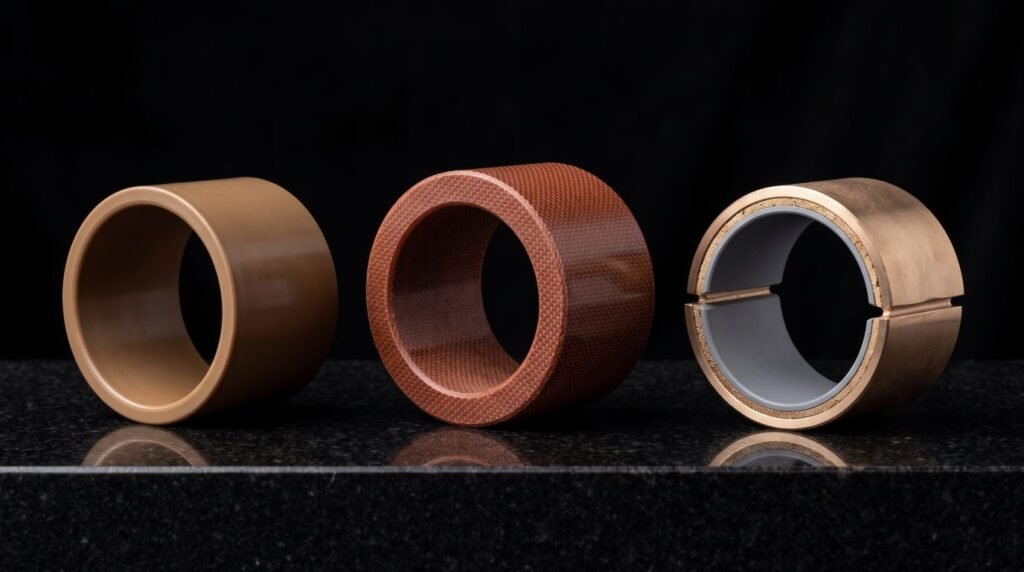
Metal-Polymer Composites (Steel/Bronze Backed): Feature a rigid metallic outer shell sintered with a porous bronze inner layer, which is then impregnated with a polymer blend (typically PTFE and specific friction modifiers). These provide the load capacity and heat dissipation of metal combined with the self-lubricating properties of polymers.
Classification by Structural Reinforcement
The structural skeleton dictates how the bushing handles static loads, impact shocks, and transverse forces.
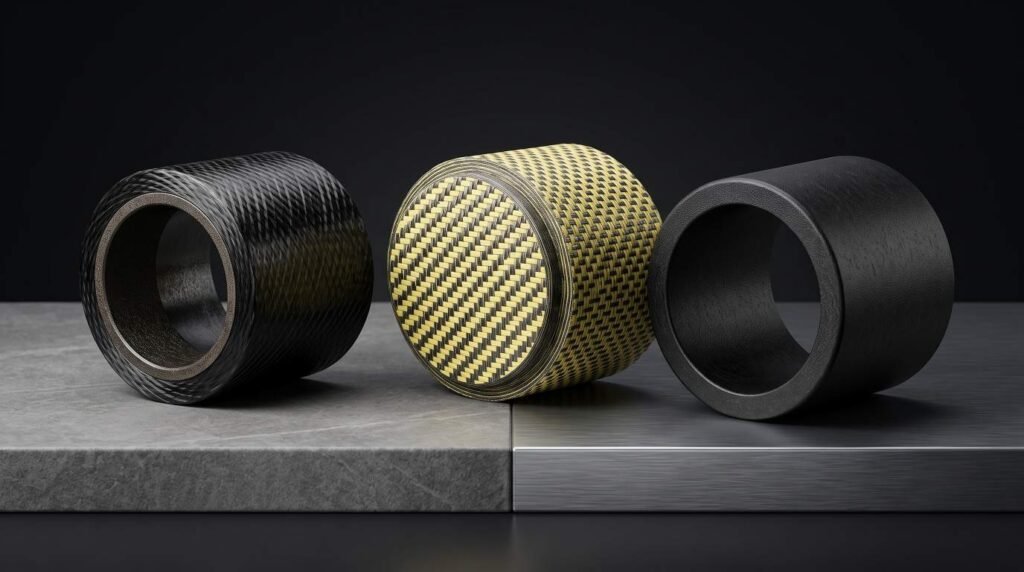
Filament Wound Composites: Manufactured by continuously winding high-strength glass or carbon fibers soaked in epoxy resin over a mandrel, featuring a tribologically modified inner wear layer. These deliver massive radial load capacities suitable for earthmoving equipment, agricultural pivots, and marine winches.
Fabric/Textile Reinforced (Laminated): Constructed using woven fabrics (cotton, polyester, Kevlar, or interwoven PTFE threads) impregnated with thermoset resins. They excel at absorbing severe vibration, high-frequency oscillation, and sudden side-load impacts without shattering.
Homogeneous Dispersed (Injection Molded): Short reinforcement fibers (glass or carbon) are uniformly mixed throughout the thermoplastic matrix. As the bushing wears, fresh layers of reinforced polymer and solid lubricant are consistently exposed to the mating shaft.
Classification by Solid Lubricant Additive
The integrated tribological additives dictate the dynamic friction coefficient and operating speed limits.
PTFE (Polytetrafluoroethylene): Provides the lowest static and dynamic friction. Ideal for preventing stick-slip in slow-moving, high-load, or reversing applications.
Graphite & Molybdenum Disulfide (MoS2): Selected for high-temperature and vacuum environments where PTFE may degrade or outgas. Graphite significantly enhances the composite’s thermal conductivity, drawing localized frictional heat away from the sliding interface.
Silicone & Micro-Oil Impregnation: Specialized polymer matrices engineered with micro-porous structures that encapsulate synthetic oils or silicone fluids. These lubricants are slowly released under mechanical pressure or thermal expansion to create a continuous hydrodynamic film during operation.
Yedra Custom Composite Bushings: Engineering Capabilities Matrix
| Customization Vector | Available Formulations & Structural Options | Maximum Engineering Limits | Target Operational Environment |
|---|---|---|---|
| 1. Base Polymer Matrix (Thermal & Chemical Foundation) |
Advanced Thermoplastics (PEEK, POM)
Highly versatile, chemical resistant, and suitable for precision injection molding or CNC machining. Heavy-Duty Thermosets (Epoxy, Phenolic) Rigid network structures that refuse to melt under high friction, preventing dimensional creep. | Max Temp (PEEK):+260°C Chemical Resistance:pH 0-14 Creep Resistance:Superior | Aggressive chemical processing, ultra-pure sanitary environments, or subsea applications where metal corrosion is a severe risk. |
| 2. Structural Reinforcement (Load Capacity Configuration) |
Continuous Filament Winding
Continuous glass or carbon fibers wound over a mandrel for extreme radial hoop strength. Fabric / Textile Lamination Woven structural layers designed to absorb and dissipate high-frequency shocks and vibrations. | Max Dynamic Load:~140 N/mm² Max Static Load:~350 N/mm² Impact Resistance:Excellent | Heavy earthmoving equipment, agricultural pivots, mining crushers, and stamping presses subject to massive side-loads and sudden shocks. |
| 3. Internal Solid Lubricants (Friction & Wear Control) |
PTFE (Polytetrafluoroethylene)
Provides the lowest static friction coefficient, preventing stick-slip during slow actuation. Graphite / MoS2 Enhances thermal conductivity to draw localized heat away from the sliding interface. | Friction Coeff (μ):0.05 - 0.15 Max Linear Speed:~1.5 m/s Dry Running:Fully Supported | Environments where external grease/oil is strictly prohibited, contaminated by dust, or washed away by constant fluid exposure. |
| 4. Geometric & Dimensional Profiling (OEM Specific Fitment) |
Precision CNC Prototyping
From standard straight cylindrical bushes to complex flanged, split, or grooved profiles. Custom Wall Thicknesses Engineered to replace existing metallic bearings without modifying the heavy equipment hardware. | Machining Tolerance:±0.02 mm Inner Diameter (ID):10mm to 500mm+ Prototyping Speed:Rapid | Aftermarket MRO (Maintenance, Repair, and Overhaul) upgrades or new OEM heavy machinery designs requiring non-standard bearing geometries. |
Heavy Construction & Mining
Standard PU wipers and scrapers act as high-pressure hydraulic seals engineered to withstand extreme shock loads, pressure spikes, and abrasive environments in heavy-duty earthmoving equipment.
Industrial Automation
These scrapers serve as precision pneumatic sealing solutions designed for low-friction and high-speed repetitive operations in modern manufacturing assembly lines.
Agricultural Machinery
They provide robust fluid power profiles built to resist UV, harsh weathering, and constant exposure to abrasive particles in open-field environments.
Fluid & Pressure Control
Standard PU wipers work alongside custom molded seals and heavy-duty O-rings formulated for reliable dynamic fluid control and leak prevention in critical valve systems.
Need a Custom Composite Bushings Solution?
Whether you need standard profiles or non-standard dimensions for your specialized composite elements (such as carbon-fiber reinforced PEEK or continuous filament-wound glass fiber), our dedicated senior designer at Yedra ensures rapid drawing output and precise prototyping. We provide seamless support from initial concept to full-scale production.
 Direct Expert Review: Skip the bureaucratic red tape. You will work directly with our dedicated senior designer to review your CAD drawings or reverse-engineer your physical samples, ensuring rapid and accurate technical communication.
- Material Optimization: We don’t just copy dimensions; we optimize for performance. We help you select the exact thermosetting resins, thermoplastics, and internal solid lubricants (such as PTFE or graphite) to withstand your specific heavy loads and harsh environments.
- Rapid CNC Prototyping: Keep your downtime to an absolute minimum. Utilizing advanced CNC turning and milling technology, we can manufacture high-precision custom bushing prototypes quickly, without the need for expensive upfront mold tooling fees.
 Direct Expert Review: Skip the bureaucratic red tape. You will work directly with our dedicated senior designer to review your CAD drawings or reverse-engineer your physical samples, ensuring rapid and accurate technical communication.
 Material Optimization: We don’t just copy dimensions; we optimize for performance. We help you select the exact thermosetting resins, thermoplastics, and internal solid lubricants (such as PTFE or graphite) to withstand your specific heavy loads and harsh environments.
 Rapid CNC Prototyping: Keep your downtime to an absolute minimum. Utilizing advanced CNC turning and milling technology, we can manufacture high-precision custom bushing prototypes quickly, without the need for expensive upfront mold tooling fees.