
Phenolic Fabric Guide Rings
Phenolic Fabric Guide Rings: High-Load Support and System Protection
We manufacture high-performance phenolic fabric guiding elements designed to withstand extreme radial loads, eliminate metal-to-metal contact, and safeguard your hydraulic and pneumatic cylinders.
Whether your equipment operates in a standard industrial facility or a harsh outdoor environment with severe vibrations and transverse forces, choosing the correct guide ring profile is the critical first line of defense against cylinder scoring and internal seal failure.
Below is an overview of our phenolic fabric guide ring profiles, engineered with advanced wear-resistant composites and robust structural geometries to ensure maximum piston and rod protection, significantly extending the overall lifespan of your fluid power systems.
Classification by Material Formulation & Additives
To meet specific friction and heat dissipation requirements in various operating environments, phenolic fabric materials are often modified:
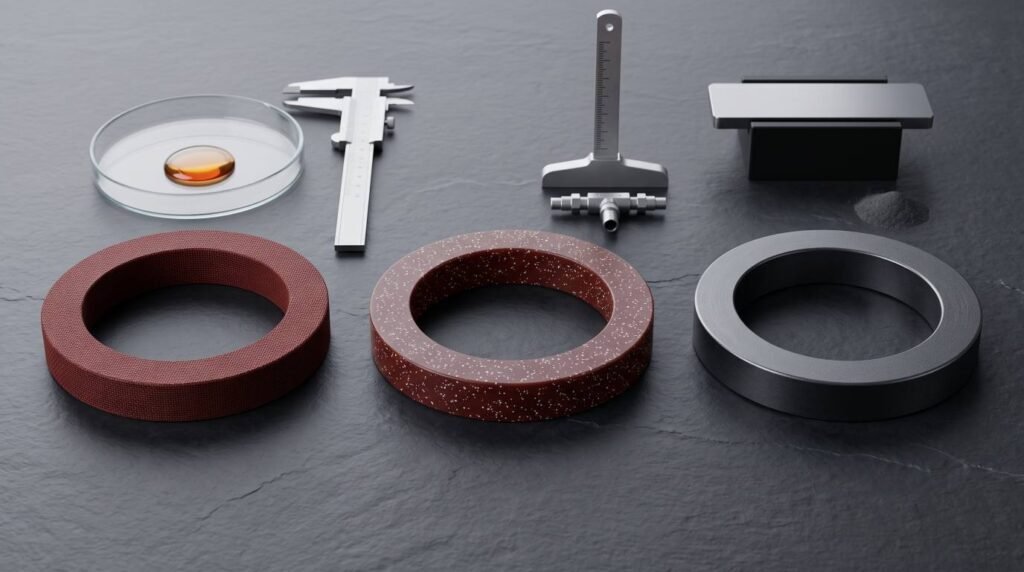
Standard Phenolic Fabric Guide Rings: Pressed solely from pure fabric and phenolic resin. These offer the most fundamental yet robust mechanical compressive strength, suitable for traditional heavy-duty equipment with adequate lubrication.
PTFE-Filled Phenolic Fabric Guide Rings: Polytetrafluoroethylene (PTFE) solid particles are uniformly dispersed within the resin matrix. While maintaining extremely high load-bearing capacity, this modification significantly reduces dynamic and static friction coefficients, effectively minimizing the “stick-slip” phenomenon during low-speed operations.
Graphite-Filled Phenolic Fabric Guide Rings: Graphite powder is added as a solid lubricant. Graphite dramatically improves the material’s thermal conductivity and wear resistance, making it particularly suitable for harsh operating conditions involving high-frequency movements or the risk of temporary dry friction.
Classification by Base Fabric Type
The material of the fabric skeleton directly determines the guide ring’s water absorption rate and ultimate strength:
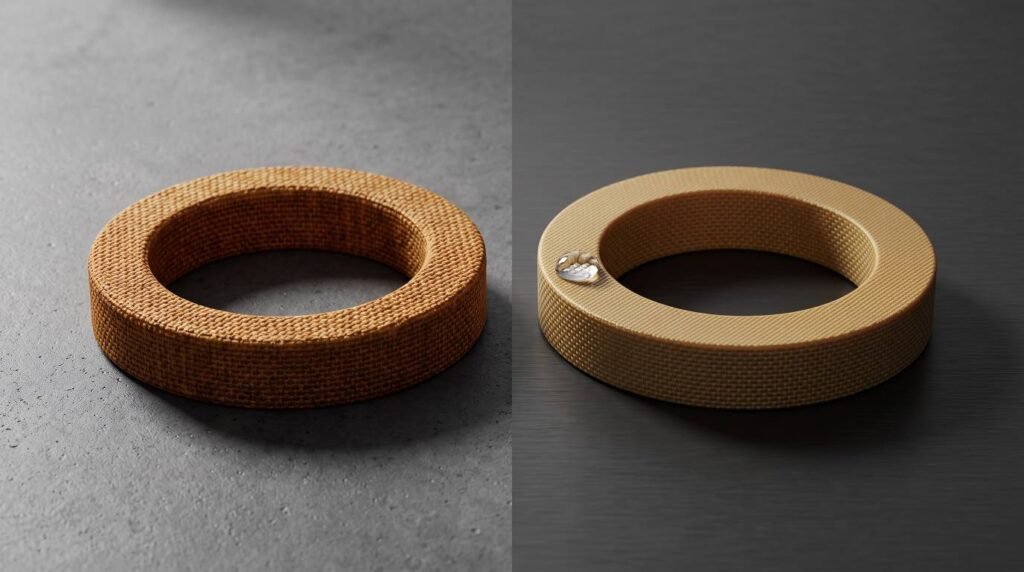
Cotton Fabric Base: The most universal standard configuration. Cotton fibers exhibit excellent adsorption for phenolic resins, resulting in a tightly bonded matrix, superior overall mechanical properties, and high cost-effectiveness.
Synthetic / Polyester Fabric Base: Utilizing synthetic fibers like polyester or aramid instead of natural cotton. The key advantage lies in its extremely low water absorption rate (virtually zero swelling), higher shear strength, and superior resistance to chemical fluid corrosion, making it ideal for water-based hydraulic fluids or high-humidity environments.
Classification by Physical Form Factor
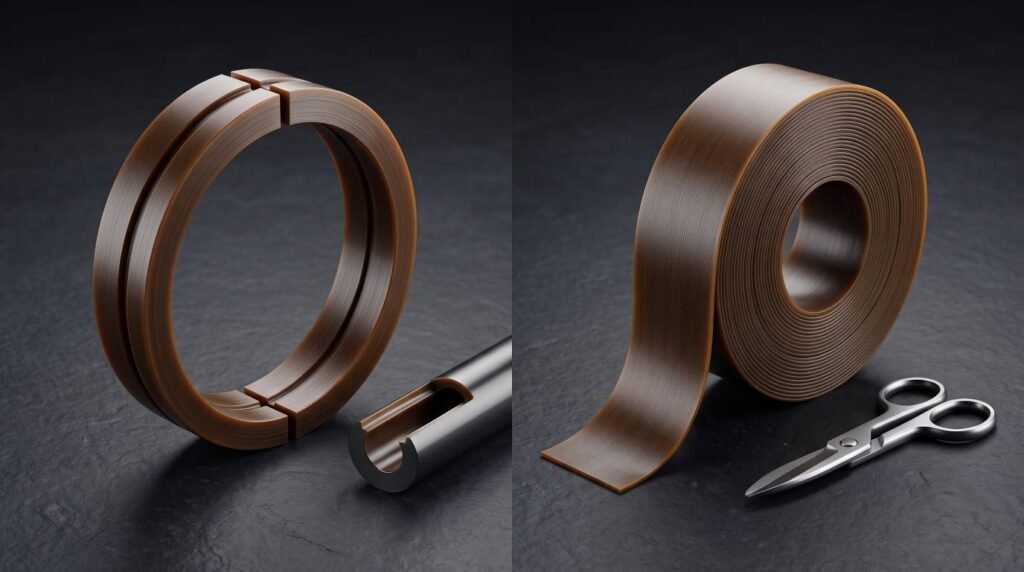
Machined Split Rings: Precision-turned and cut with specific openings (angle cut, straight cut, or step cut) with extremely tight tolerances. They snap directly into closed housing grooves and are suitable for high-precision hydraulic cylinders.
Extruded / Laminated Strips (By the Roll): Supplied in long continuous rolls, cut to size on-site by personnel according to the cylinder’s outer diameter. This provides immense inventory flexibility for maintenance, repair, and overhaul (MRO) operations.
Core Physical Characteristics & Technical Advantages
Phenolic fabric guide rings are positioned as the “heavy armor” in fluid power systems. Their core advantages are reflected in the following aspects:
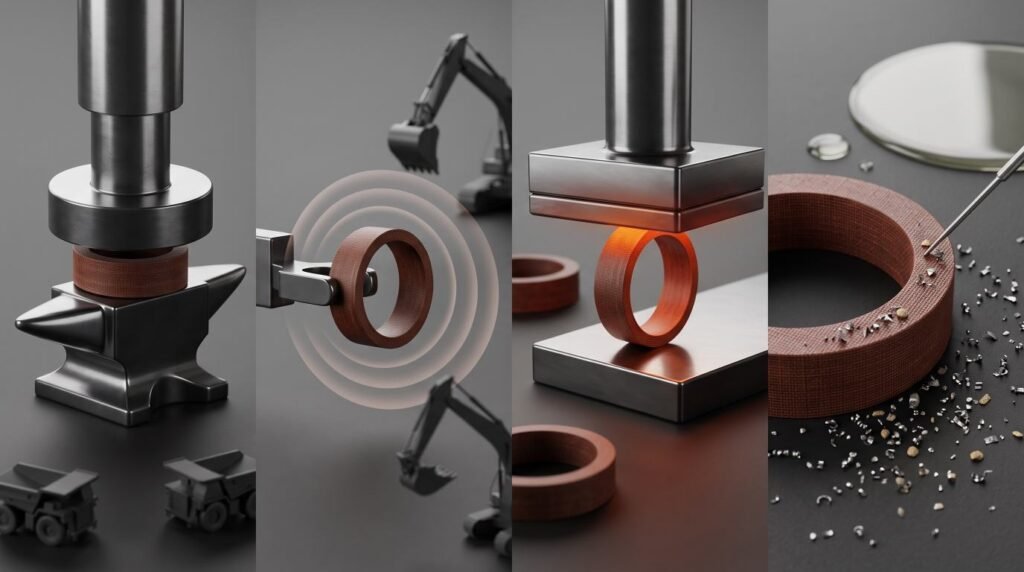
Extreme Compressive Strength: The composite structure of thermosetting resin and high-strength fabric grants it a compressive capacity far exceeding that of POM, Nylon, and PTFE. It can withstand extreme radial loads (typically handling surface pressures up to 300 to 350 N/mm²), making it the premier choice for heavy mining equipment and massive industrial presses.
Superior Shock & Vibration Absorption: The fabric matrix possesses microscopic flexibility and an elastic modulus that effectively absorbs severe high-frequency vibrations and sudden transverse shocks generated by heavy machinery (like excavators and rock crushers) in harsh conditions, protecting the cylinder bore lining.
Excellent Thermal Stability & Creep Resistance: As a thermosetting plastic, phenolic resin will not melt at high temperatures, nor does it suffer from severe “cold flow” (creep) like thermoplastics (such as virgin PTFE). It maintains extremely high dimensional accuracy even at operating temperatures up to +120°C to +130°C.
Dirt Embedding & Marginal Lubrication Capability: The microscopic mesh structure of the fabric material can store trace amounts of hydraulic oil, performing exceptionally well under marginal lubrication (broken oil film) conditions. Simultaneously, it has a specific dirt-embedding capacity, allowing it to trap tiny hard particles (such as metal shavings or sand) that invade the system into its soft fabric matrix, preventing these particles from directly scoring the expensive metal cylinder walls.
| Classification Matrix | Specific Variant | Rigorous Technical Specifications | Primary Application & Advantage |
|---|---|---|---|
| By Material Formulation & Additives | Standard Phenolic Fabric |
Compressive Strength: ~340 N/mm² Dynamic Friction (μ): 0.15 - 0.20 Max Operating Temp: +120°C | Traditional heavy-duty excavators and mining presses. Provides maximum radial load capacity with adequate mineral oil lubrication. |
| PTFE-Filled Phenolic |
Compressive Strength: ~280 N/mm² Dynamic Friction (μ): 0.08 - 0.12 Stick-Slip Phenomenon: Negligible | Systems requiring extremely smooth, low-speed actuation. The PTFE dispersion minimizes friction while maintaining high load bearing. | |
| Graphite-Filled Phenolic |
Compressive Strength: ~310 N/mm² Thermal Conductivity: Enhanced Max Operating Temp: +130°C | High-frequency oscillating cylinders and environments with marginal lubrication. Graphite acts as a superior solid lubricant and heat sink. | |
| By Base Fabric Material | Cotton Fabric Base |
Water Absorption: 1.5% - 2.0% Resin Adhesion: Excellent Fluid Compatibility: Mineral Oils (HLP) | The industry standard for general hydraulic fluids. Highly cost-effective with robust mechanical integration between fabric and resin. |
| Synthetic (Polyester) Base |
Water Absorption: < 0.2% Dimensional Swelling: ≈ 0.0% Fluid Compatibility: HFC, HFA Fluids | Marine, offshore, and subterranean mining equipment. Essential when using water-glycol fire-resistant fluids to prevent material swelling and seizing. | |
| By Manufacturing Form Factor | Precision Machined Rings |
Wall Thickness Tol: -0.02 to -0.05 mm Gap Configurations: 30° / 45° / Step Installation: Snap-in (Closed Groove) | High-precision OEM cylinder manufacturing requiring strict dimensional control and guaranteed hydrodynamic fluid film clearances. |
| Extruded Strip (Rolls) |
Standard Lengths: 5m / 10m rolls Standard Widths: 5.6mm - 40mm Customization: Cut-to-length on site | Ideal for MRO (Maintenance, Repair, and Overhaul). Provides maximum inventory flexibility for mechanics repairing various unknown cylinder bore diameters. |
Heavy Construction & Mining
Phenolic fabric guide rings act as heavy-duty bearings engineered to withstand extreme radial loads, severe high-frequency vibrations, and massive shock impacts in earthmoving and mining equipment.
Industrial Automation
These composite rings serve as rigid structural supports designed for heavy industrial presses and high-load automated machinery, maintaining strict dimensional stability under continuous operational stress.
Agricultural Machinery
They provide exceptional dirt-embedding capabilities and marginal lubrication performance, protecting cylinder walls from scoring caused by abrasive particles and transverse shocks in open-field environments.
Fluid & Pressure Control
Phenolic guide rings work alongside primary high-pressure seals to maintain absolute cylinder concentricity, preventing metal-to-metal contact and ensuring reliable dynamic performance in critical fluid power systems.
Need a Custom Standard PU Wipers / Scrapers Solution?
“Whether you need standard profiles or non-standard dimensions, our dedicated senior designer ensures rapid drawing output and precise prototyping. We provide seamless support from initial concept to full-scale production.”
My apologies for the stubborn translation loop earlier—I have it strictly in English for you now.
 Direct Expert Review Skip the bureaucratic red tape. You will work directly with our dedicated senior designer to review your CAD drawings or reverse-engineer your physical samples, ensuring rapid and accurate technical communication.
- Material Optimization We don’t just copy dimensions; we optimize for performance. We help you select the exact elastomer or polymer (such as specialized FKM, NBR, or PTFE) to withstand your specific chemical fluids and thermal environments.
- Rapid CNC Prototyping Keep your downtime to an absolute minimum. Utilizing advanced CNC turning technology, we can manufacture high-precision custom prototypes quickly, without the need for expensive upfront mold tooling fees.
 Direct Expert Review Skip the bureaucratic red tape. You will work directly with our dedicated senior designer to review your CAD drawings or reverse-engineer your physical samples, ensuring rapid and accurate technical communication.
 Material Optimization We don’t just copy dimensions; we optimize for performance. We help you select the exact elastomer or polymer (such as specialized FKM, NBR, or PTFE) to withstand your specific chemical fluids and thermal environments.
 Rapid CNC Prototyping Keep your downtime to an absolute minimum. Utilizing advanced CNC turning technology, we can manufacture high-precision custom prototypes quickly, without the need for expensive upfront mold tooling fees.