

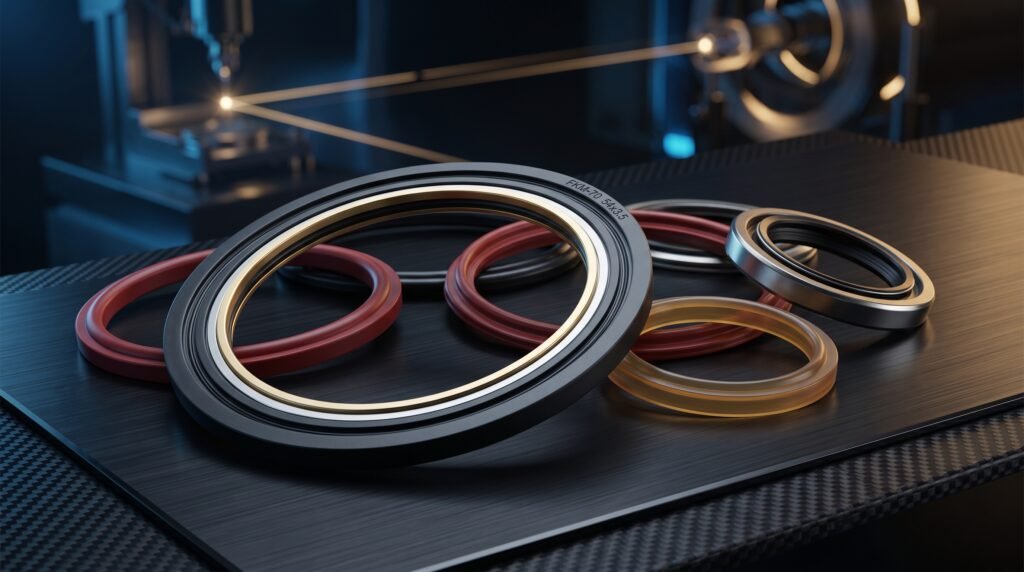
.Leaks in high-pressure fluid transfer systems are the bane of any heavy-duty mechanical assembly. As a lead design engineer at Bingoo, I’ve analyzed far too many catastrophic, multi-million-dollar equipment failures stemming from a sealing component that costs mere pennies to produce.
When overseas clients partner with us as their custom FKM seal manufacturer, they usually bring us problems that standard, off-the-shelf NBR or commercial-grade O-rings cannot solve. Recently, a project brief for a heavy industrial hydraulic actuation system landed on my desk. The requirements were brutally uncompromising: withstand continuous operating temperatures of 220°C, resist aggressively formulated synthetic lubricants, and maintain a bubble-tight seal under dynamic pressure spikes peaking at 5,000 PSI. Surviving this environment required a ground-up redesign, rethinking everything from polymer chemistry to physical geometry.
Formulating for the Extreme: Advanced FKM Chemistry
The foundation of any high-performance B2B sealing solution is its material matrix. I spent the first three weeks of the development cycle coordinating closely with our materials science lab to formulate a bespoke compound. After rigorous testing, we bypassed standard elastomers and settled on a high-fluorine terpolymer FKM.
However, the raw base polymer is only half the equation; the real engineering happens in the cross-linking system. To push the thermal stability significantly higher, we opted for a precise bisphenol cure rather than a standard peroxide cure. This was coupled with a proprietary carbon black filler dispersion technique. The result gave us a Shore A hardness of 75—the absolute sweet spot providing both the necessary extrusion resistance and the conformability required to fill microscopic hardware imperfections. When I reviewed the initial compression set data, which showed under 12% deformation after 70 hours at 200°C, I knew we had nailed the material foundation that separates a reliable B2B hydraulic seal supplier from a generic mass-producer.
Why Choose a Custom Seal for Your System
A major misconception outside of our discipline is that a sealing ring is just a simple rubber donut. For this specific high-pressure application, a standard circular cross-section would inevitably roll under dynamic cycling, leading to catastrophic spiral failure.
I booted up my finite element analysis (FEA) workstation and began iterating on a modified multi-lobe profile. We ultimately engineered a custom X-ring geometry with asymmetric dynamic contact lips. By adding calculated micro-chamfers to the inner diameter, I ensured a localized area of high contact stress to effectively wipe the mating rod surface clean. I distinctly remember running a non-linear hyperelastic simulation late on a Thursday night. The stress contours perfectly illustrated that as the fluid pressure increased, the seal’s geometry actively deformed to widen its contact footprint against the hardware groove. The seal wasn’t just resisting the pressure; it was using the fluid pressure to actively seal tighter.
To further reduce breakaway friction, we applied a microscopic PTFE-based dry film lubricant. The application process chemically bonds the fluoropolymer directly to the FKM substrate, lowering the dynamic coefficient of friction by nearly 40% and eliminating the “stick-slip” phenomenon that plagues hydraulic cylinders after long periods of inactivity.
Precision Tooling for Wholesale Custom Seals
Of course, a perfect CAD model is entirely useless if you cannot manufacture it reliably at scale. As a dedicated custom seal manufacturer, Bingoo heavily invests in the tooling phase. I worked directly on the shop floor with our machinists to design the steel compression molds, holding the tool cavity tolerances to a staggering ±0.015 mm.
Flash—the excess material that escapes at the mold parting line—is the ultimate enemy of a flawless seal. To mitigate this for bulk production, I designed the tooling so that the parting line was positioned entirely outside the critical dynamic sealing footprint. After the primary molding phase, we implemented a rigorous 24-hour, step-up post-cure cycle in a circulating air oven. This exhaustive process drives off volatile byproducts and fully links the polymer chains, maximizing the ultimate tensile strength. When handling wholesale high-pressure O-rings for international clients, this level of quality control ensures zero risk of off-gassing in service.
From Prototype to Reliable B2B Production
It is always a tense moment when you physically pressurize a new mathematical design to its limits on the burst test rigs. We subjected the prototypes to 100,000 continuous cycles of pressure impulses from zero to 5,000 PSI at severely elevated temperatures. Upon breaking down the test fixture, the rings looked virtually untouched—no nibbling, no explosive decompression damage, and zero measurable volume swell.
It is incredibly easy to overlook a sealing ring. It sits hidden inside a massive assembly, doing its job quietly in the dark. But for an engineer, there is profound satisfaction in perfecting that invisible component. Knowing that our engineered designs are out in the field, keeping critical machinery running safely under some of the harshest conditions on earth, is exactly why Bingoo focuses strictly on high-end B2B industrial solutions.
Are you experiencing recurring seal failures, or looking for a reliable manufacturing partner for your next fluid power project? As a specialized custom FKM seal manufacturer, Bingoo is equipped to handle complex geometric designs and custom material formulations. Reach out to our engineering team today to discuss your specifications, request a material datasheet, or inquire about wholesale production timelines.