

Overcoming Production Bottlenecks: The Engineering Case for Custom Automation
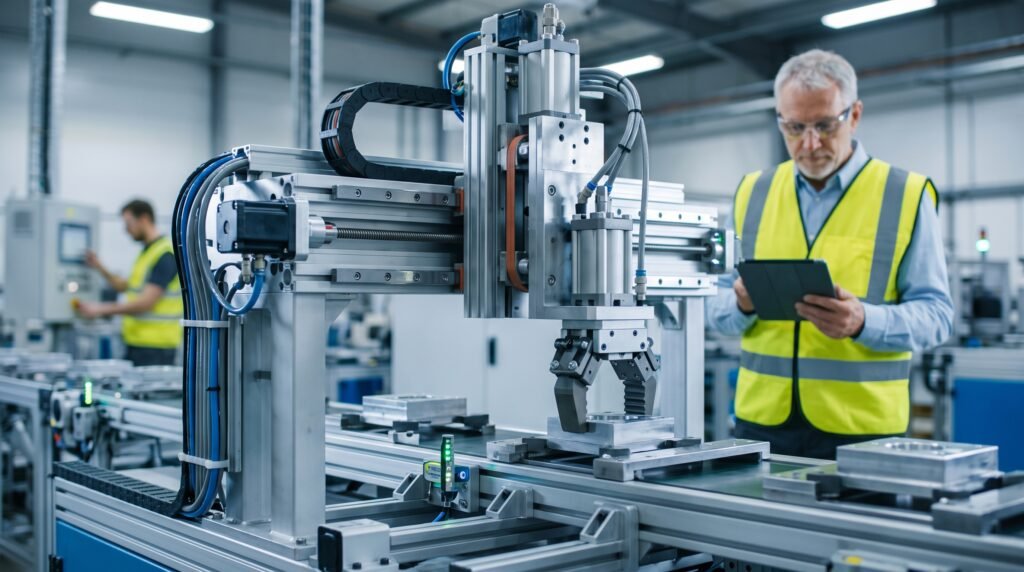
When optimizing a manufacturing line, relying on off-the-shelf machinery often leads to a hard ceiling in productivity. Standard equipment is engineered for universal compatibility, not for the unique constraints of highly specialized processes. When cycle times stagnate or defect rates spike due to irregular part handling, trying to force-fit a standard machine into a complex process usually results in excessive downtime, frequent tooling adjustments, and a compromised OEE (Overall Equipment Effectiveness).
To break through these production bottlenecks, facilities require custom non-standard automation. This is not about reinventing the wheel; it is about engineering a targeted, mechanical solution that aligns perfectly with your specific takt time, footprint constraints, and material requirements.
The Engineering Framework: From Concept to Commissioning
A successful custom automation project relies on a rigorous, data-driven engineering workflow rather than trial and error. Here is how we approach complex production challenges:
1. Deep-Dive Requirement Assessment
Before any design work begins, we analyze the mechanical physics of the bottleneck. We evaluate the current cycle times, payloads, spatial limitations, and the specific material properties of the handled components. By establishing a clear baseline of the required tolerance thresholds and throughput targets, we ensure the foundational design logic is sound.
2. 3D Modeling and Kinematic Validation
We translate the conceptual solution into highly detailed 3D CAD models. At this stage, we utilize kinematic simulation and collision detection software to visualize moving parts in real-time. This digital twin approach allows us to verify robotic reach, sequence timing, and load distributions, effectively eliminating structural flaws before a single piece of metal is machined.
3. Precision Component Selection for High-Wear Environments
The reliability of an automation cell is only as strong as its weakest component. For heavy-duty or high-frequency applications, selecting the right pneumatics, hydraulics, and wear-resistant MRO components is critical. We integrate specialized spring-energized PTFE seals, custom molded elastomers, and PEEK guide rings within our pneumatic and rotary shaft mechanisms. This meticulous approach to sealing and wear resistance ensures stable operation in harsh environments (such as high dust, chemical exposure, or extreme temperatures) and drastically extends the MTBF (Mean Time Between Failures).
4. Machining, Assembly, and Iterative Debugging
Following CNC fabrication with strict adherence to GD&T (Geometric Dimensioning and Tolerancing) standards, the physical build begins. Mechanical assembly is paired with precise PLC logic programming. The equipment then undergoes rigorous FAT (Factory Acceptance Testing), where we simulate production loads to fine-tune sensor calibration, actuator timing, and overall mechanical stability.
The Technical and Financial Advantages of Custom Engineering
Investing in non-standard automation provides structural advantages that directly impact your bottom line:
Engineered for Durability: Standard machines often utilize generic components that wear quickly under specialized stress. By engineering the exact mechanical structures required—and integrating superior wear bands and sealing technologies—we minimize friction and fatigue, directly lowering your Total Cost of Ownership (TCO).
Maintenance-Centric Design: Custom equipment is designed with your maintenance crew in mind. We prioritize modular assemblies and accessible service points, turning what would normally be a four-hour teardown on a standard machine into a 20-minute rapid-swap procedure.
Predictable ROI: While the initial CapEx for custom automation is higher than purchasing standard units, the elimination of manual workarounds, reduced scrap rates, and maximized uptime typically yield a highly predictable and accelerated return on investment.
Evaluate Your Production Bottleneck
If standard equipment is failing to meet the demands of your unique manufacturing process, a custom-engineered solution is the most logical next step.
Submit your process flow requirements or 2D/3D CAD drawings to our engineering team today. We will conduct a thorough technical evaluation and provide a transparent, data-driven proposal detailing how a custom automation cell can resolve your specific production bottleneck.
For manufacturing technical directors, unresolved production bottlenecks are systemic risks. When a high-volume assembly line slows down due to an intricate or irregular process, standard off-the-shelf machinery often falls short. Standard equipment is engineered for universal compatibility, not for the unique tolerances, component shapes, or environmental constraints of specialized production lines.
Trying to force-fit a standard machine into a complex process usually results in excessive downtime and a compromised OEE (Overall Equipment Effectiveness). To break through these limitations, facilities require custom non-standard automation—engineered specifically to solve your exact physics, tolerances, and throughput constraints.
The Engineering Framework: From Concept to Factory Floor
A successful custom automation project relies on a rigorous, data-driven engineering workflow to ensure mechanical reliability from day one:
1. Deep-Dive Requirement Assessment: We evaluate the exact boundary conditions of your bottleneck. This includes analyzing specific cycle times (takt time), payloads, spatial footprints, and GD&T (Geometric Dimensioning & Tolerancing) constraints.
2. 3D Modeling & Kinematic Simulation: Before any CNC machining begins, we build highly detailed 3D CAD models. Using kinematic and multi-body simulation software, we verify sequence timing, load distributions, and eliminate collision risks virtually.
3. Precision Sourcing for High-Wear Environments: An automation cell is only as durable as its components. We integrate high-grade pneumatics, custom molded elastomers, and wear-resistant PEEK guide rings to ensure stable operation in abrasive or chemically harsh environments, drastically extending MTBF (Mean Time Between Failures).
4. Assembly & Factory Acceptance Testing (FAT): Following precision fabrication, mechanical assembly is paired with optimized PLC logic. The equipment undergoes rigorous FAT under real-world production loads to fine-tune sensor calibration, actuator timing, and overall mechanical stability.
Engineering for Maintenance and ROI
Experienced engineers design custom machinery not just for speed, but to reduce long-term operational expenditure (OpEx). By prioritizing modular assemblies and accessible service points, a complex teardown on a standard machine becomes a rapid-swap procedure on a custom build.
Financially, while the initial CapEx for custom automation is higher, the return on investment is highly predictable. By reallocating labor, drastically reducing scrap rates, and minimizing unexpected downtime, custom engineering projects typically yield an accelerated ROI, often paying for themselves in under 12 months.
Submit Your Process Challenge
If standard equipment is failing to meet the demands of your unique manufacturing process, a custom-engineered solution is the most practical path forward.
Submit your process flow requirements, cycle time targets, or 2D/3D CAD drawings to our engineering team today. We will conduct a thorough technical evaluation and provide a transparent, data-driven proposal on how custom automation can permanently resolve your production bottleneck.